



MiG-23 FLOGGER
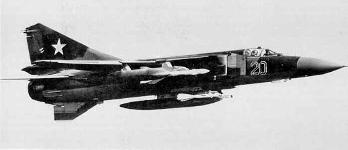
YF-113Meant as a point defense fighter, the Flogger offered a powerful radar, an infrared search and track system, a selection of radar and infrared guided weapons and tremendous speed (Mach 2.35) to counter its adversaries. The MiG-23 was designed in 1964-66 as a successor to the MiG-21. In addition to a much more powerful engine, the MiG-23's most significant new feature was its variable sweep wing. Like the USAF's swing wing F-111, the sweep of the wings could be changed in flight. Fully spread, this gives a shorter takeoff/landing roll while carrying a heavier weapons load. With the wings fully swept back, the MiG-23 has greater speed. The wing has three sweep settings: 16, 45, and 72 degrees. The prototype first flew in April 1967 and MiG-23s began entering operational service in 1971.
The aircraft is in widespread use in Eastern Europe and the Middle East. The MiG-23/27 FLOGGER series of aircraft has been used extensively by the former Soviet Union and its Warsaw Pact allies including Poland, Hungary, Bulgaria, East Germany, Rumania, and Czechoslovakia. Other countries including Libya, Syria, Egypt, India, Cuba, Algeria, Iraq, Afghanistan and North Korea have imported FLOGGERS.
The MiG-23 series served as fighter-interceptors, with a secondary capability of ground attack. The MiG-23BN and MiG-27 were fighter-bomber variations. The Flogger B is a standard interceptor. Other versions of this aircraft are: C--two seater; G--improved interceptor; and E--export. The MiG-23MLD FLOGGER K version was a modification of the MiG23ML FLOGGER G and incorporated improved avionics, armament, and aerodynamic features. The MiG-23MLD is the most advanced version of the Flogger. It features a different identification-friend-or-foe system, a more advanced missile capability and a distinctive notch in the leading edge of the wing to improve flight characteristics. More than 4,000 MiG-23/27s are estimated to have been built.
The wings are high-mounted, variable, swept-back, and tapered with blunt tips. There is one turbofan engine inside the body. There are rectangular, box-like air intakes forward of the wing roots and a single exhaust. The fuselage is long and tubular, except where intakes give a box-like appearance. It has a long, pointed nose and a stepped canopy. There is a large, swept-back, and tapered belly fin under the rear section. The tail is swept-back, has a tapered tail fin, has a curved dorsal in the leading edge and an angular tip. Swept-back, tapered flats have angular tips and are high-mounted on the fuselage.
MiG-23 aircraft acquired by the United States under the Foreign Materiel Acquisition/Exploitation program are designated as the YF-113.
Specifications
Country of Origin CIS (formerly USSR) Variants MiG-23M Flogger B MiG-23MF Flogger B MiG-23UB Flogger C MiG-23UM Flogger C MiG-23MF Flogger E MiG-23MS Flogger E MiG-23BN Flogger F MiG-23BM Flogger F MiG-23B Flogger F MiG-23ML Flogger G MiG-23P Flogger G MiG-23BK Flogger H MiG-23BN Flogger H MiG-23MLD Flogger K MiG-24 (export MiG-23) Similar Aircraft MiG-27 Flogger D Tornado Su-24 Fencer F-111 Crew one MiG-23U -- two MiG-23C -- two Role interceptor fighter Length 55 ft (16.6 m) Span 46 ft, 9 in (14.26 m) Ceiling 18600 meters Cruise range 970 nm In-Flight Refueling No Internal Fuel 4600 kg Payload 2000 kg Sensors High Lark radar, RWR, IRST, Basic Bombsight Drop Tanks 800 L drop tank with 639kg of fuel for 67nm range Armament Cannon: GSh-23L 23mm
AS-7 Kerry, UV-16-57, FAB-500, AA-7, ,AA-8, AA-10, AA-11User Countries Afghanistan Algeria Angola Belarus Bulgaria CIS Cuba Czech Republic Germany Ethiopia Hungary India Iraq Kazakhstan Libya North Korea Poland Romania South Yemen Sudan Syria Ukraine Vietnam
VRML 3-D Model
Mig-23 Flogger
Wings spread
VRML by Soji Yamakawa
Mig-23 Flogger
Wings swept back
VRML by Soji Yamakawa




Sources and Resources
- JOHN T. MANCLARK November 1985 - November 1987, squadron commander, 4477th Test and Evaluation Squadron, Nellis Air Force Base, Nev. -- Aircraft flown: T-38, F-4C/D/E, F-5E, YF-110 and YF-113
- COLONEL "HAWK" CARLISLE - December 1986 - December 1988, chief of weapons and tactics and flight commander, 4477th Test and Evaluation Squadron, Nellis Air Force Base, Nev. Aircraft flown: AT-38, YF-110, YF-113, T-38, F-15


